
Digital-Native Rights: The Next Commercial Frontier.
As audiences fragment, the winners will be those who architect fan relationships directly — not through intermediaries.
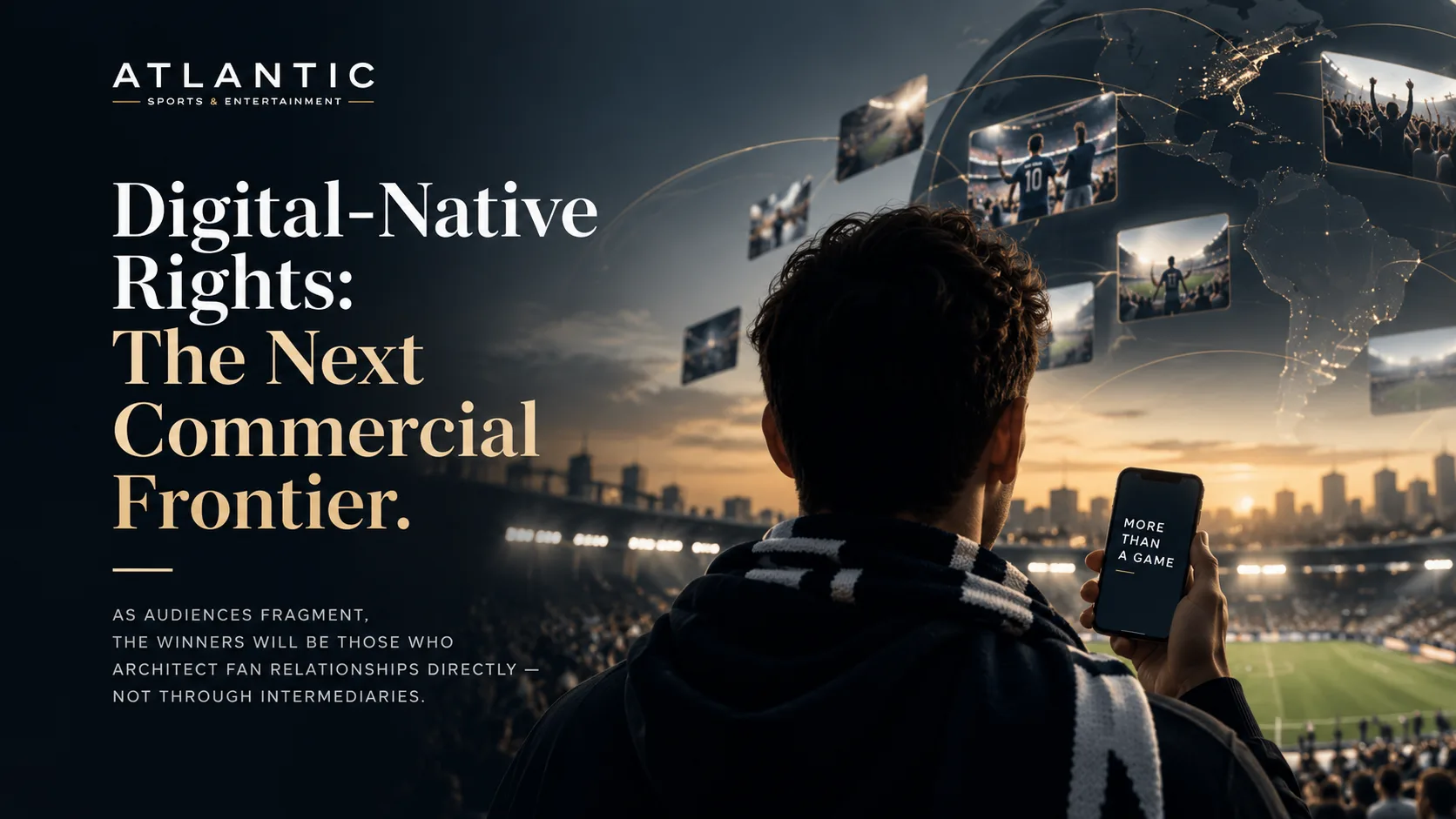
Digital-Native Rights: The Next Commercial Frontier
The next battle in sports rights will not be about who distributes the game. It will be about who owns the relationship with the fan.
For decades, the sports business has been built around one central asset: the right to show the game.
That right remains extremely valuable. Broadcast and streaming deals will continue to represent a major source of revenue for clubs, leagues and federations.
But something important is changing.
The most valuable commercial relationship is increasingly moving closer to the fan — and away from the traditional distribution layer.
A broadcaster can deliver an audience. A social platform can generate reach. An advertiser can buy attention.
But none of those necessarily gives the rights holder a direct, lasting relationship with the person watching.
That distinction will matter more and more.
The sports properties that understand this early will have an opportunity to build a second layer of value around their traditional media rights: digital-native rights built around identity, participation, commerce and direct fan relationships.
This is not about replacing television.
It is about making the underlying sports property more valuable beyond television.
The direct-to-fan thesis
The sports industry has spent decades optimizing distribution.
The next phase will be about ownership of the relationship.
A club may know that ten million people watched a match. That is useful.
But knowing that 200,000 of those people are members, 80,000 regularly buy merchandise, 25,000 travel internationally to attend matches and 10,000 are high-value customers is a different kind of asset.
It creates something much closer to a customer base than an audience.
That is the fundamental opportunity.
The question is no longer only:
How many people can we reach?
It becomes:
How many fans can we identify, understand and serve directly?
That shift has commercial consequences.
A fan who watches a match once generates media value.
A fan who can be identified, engaged, sold to, retained and brought back over many years generates something much more valuable: lifetime commercial value.
Where the value moves
1. From audience data to first-party relationships
The first opportunity is ownership of the relationship itself.
Ticketing, memberships, merchandise, subscriptions, content consumption, hospitality and events have historically operated as separate commercial activities.
Digital platforms can bring those interactions together.
The result is a much clearer picture of the individual fan.
Not simply:
"This person watched the match."
But:
"This is a 28-year-old supporter in Mexico who follows a particular player, watches most international matches, bought a shirt last season and has previously purchased tickets when visiting the club's home city."
That information has obvious commercial value.
It allows clubs and leagues to sell more intelligently, serve fans better and offer sponsors something more meaningful than a logo next to a piece of content.
It also reduces dependence on third parties for basic knowledge about the audience.
2. The match becomes a commercial moment
Sports have always generated emotion.
Digital technology makes it possible to act on that emotion immediately.
A goal can trigger a merchandise offer.
A player's record can trigger a limited-edition product.
A championship can trigger a membership campaign.
A fan watching from another country can receive an invitation to a local event.
The important point is not simply that sports can sell more products online.
It is that the commercial opportunity can now appear inside the fan experience itself.
The distance between watching, engaging and buying becomes much shorter.
This creates an entirely new layer of value around the live event.
3. New rights can be created around the existing rights
This is where the opportunity becomes particularly interesting for rights holders.
Traditional rights categories are relatively well understood: media, sponsorship, licensing, merchandising, hospitality and so on.
Digital creates additional possibilities.
Who owns the right to run an interactive prediction during a match?
Who can sponsor a fan vote?
Who can offer a location-specific promotion to supporters watching from a particular market?
Who can personalize an experience for a particular audience?
Who can turn a major sporting moment into an immediate commerce opportunity?
These are rights that were difficult to define — let alone sell — when the primary commercial relationship was between the sports property and a broadcaster.
They become much more tangible when the rights holder has its own digital relationship with the fan.
The real shift: from packages to relationships
For years, sports rights have largely been sold as packages.
A broadcaster buys a package.
A sponsor buys a category.
A licensee buys a territory.
A partner receives a set of assets.
Digital-native rights introduce another possibility.
Instead of asking only what assets can be packaged and sold, rights holders can ask:
What new commercial opportunities can be created around the same fan relationship?
The same match can generate media revenue, sponsorship exposure, merchandise sales, membership sign-ups, hospitality demand and partner transactions.
The underlying sporting asset has not changed.
What changes is the number of commercial layers that can be built around it.
That is why this is not simply a technology story.
It is a rights-management story.
The move from impressions to lifetime value
There is also a broader change in the way sports audiences can be valued.
Traditional media economics are largely built around reach and impressions.
Those metrics remain important.
But they tell only part of the story.
If a club can identify a supporter and maintain a relationship with that person for ten, twenty or thirty years, the economic value of that relationship is not captured by the number of impressions generated by any individual match.
It can include:
- memberships;
- merchandise;
- tickets;
- hospitality;
- subscriptions;
- travel and experiences;
- partner offers;
- events;
- digital products.
This changes the investment case for digital infrastructure.
A first-party platform should not be viewed simply as another media channel.
If built correctly, it can become commercial infrastructure for the rights holder.
Global fans are no longer distant fans
There is another important consequence.
A club no longer needs to build a physical presence in a market before it can begin building a relationship there.
A supporter in India, Mexico, the United States or the Middle East can become part of a club's digital community long before attending a match or visiting the stadium.
That relationship can eventually lead to merchandise, events, memberships, hospitality, partnerships and physical experiences.
Digital therefore creates a different path to international growth:
relationship first, physical presence later.
For clubs with strong global brands, that can be particularly powerful.
AI will help. It is not the thesis.
Artificial intelligence will make personalization, content production and audience analysis more efficient.
But AI itself is not the opportunity.
The opportunity is the relationship.
AI can help a club understand which supporters are becoming more engaged, which offers are relevant to them and what content they are most likely to consume.
But without a meaningful first-party relationship, there is much less to work with.
The competitive advantage will therefore not come simply from having better technology.
It will come from having better relationships and better data — and using technology to make those relationships more valuable.
What this means for the next generation of rights deals
The next major rights negotiations will increasingly involve questions beyond the traditional media package.
Who owns the fan relationship?
Who controls the data?
Who can communicate directly with supporters?
Who can activate them during a live event?
Who can monetize commerce?
Who controls digital inventory in different markets?
Who captures the transaction?
And ultimately:
Who owns the relationship after the match ends?
These questions may become as important as the number of matches included in a broadcast package.
That does not make broadcasters less relevant.
Quite the opposite.
Broadcasters will remain essential to reaching mass audiences.
But the strongest rights holders may increasingly use distribution partners for reach while building their own infrastructure for the relationship that follows.
The commercial frontier is closer than it looks
The sports industry does not need to invent a new sport to create new value.
The games already exist.
The fans already exist.
The content already exists.
What is changing is the ability to connect those assets directly.
That is why Digital-Native Rights may become one of the most important commercial developments in sports over the next decade.
The question is no longer simply who has the rights to show the game.
It is who can turn those rights into a direct relationship with the people who care about it.
Broadcast rights monetize attention.
Digital-native rights can monetize the relationship behind that attention.
And that relationship may ultimately become the most valuable asset of all.