
From Arenas to Districts: Building for a Generation.
The venues that will matter most are no longer buildings — they are city-shaping platforms with 40-year horizons.
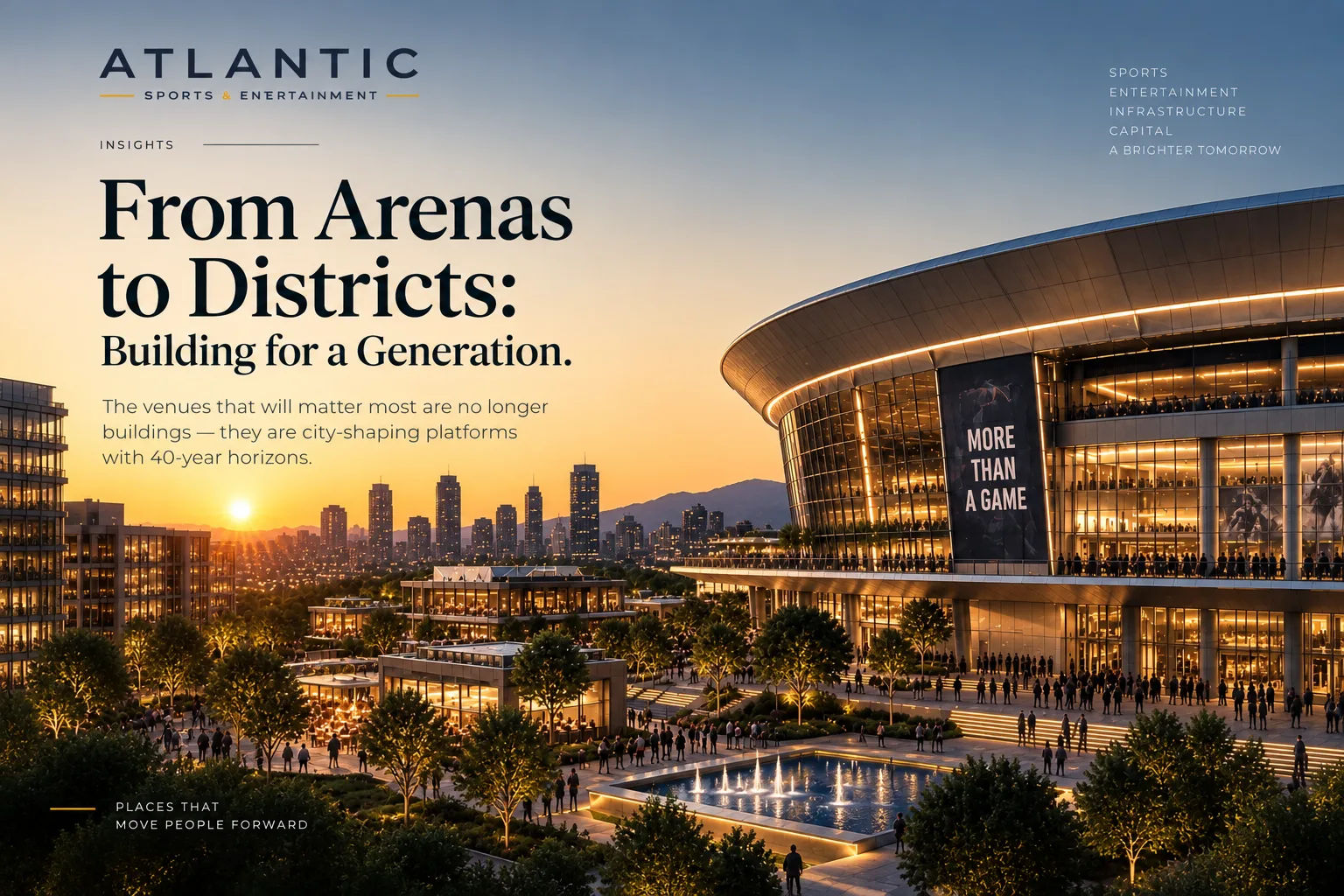
From Arenas to Districts: Building for a Generation
The venues that will matter most are no longer buildings — they are city-shaping platforms with 40-year horizons.
Beyond the building
For decades, sports infrastructure was largely viewed through the lens of the venue itself: the stadium, the arena, the training centre.
That is changing.
The most ambitious projects are beginning to treat the venue as an anchor within something much larger — a district where sport, entertainment, hospitality, retail, residential, commercial and public spaces work together.
The question is no longer simply:
How do we build a great arena?
It is:
How do we create a destination that remains valuable when there is no game on?
That shift changes almost everything: how a project is planned, financed, commercialized and measured.
A stadium can host events.
A district can shape a city.
The venue is the anchor, not the destination
A modern sports destination might include an arena or stadium at its centre, surrounded by hotels, restaurants, retail, offices, residential development, entertainment, museums, public spaces and mobility infrastructure.
The objective is not to make every square metre serve the sport.
It is to make the sport the reason people come — and give them reasons to stay.
This creates a fundamentally different economic model.
Instead of relying primarily on ticketing and event-day revenues, the project can generate value through hospitality, commercial real estate, naming rights, sponsorship, retail, entertainment, tourism, events and other forms of activation throughout the year.
The venue becomes the anchor.
The district becomes the asset.
Why this compounds
The economics of a destination can be significantly more powerful than those of a standalone venue because value is created in several places at once.
There is revenue generated by the venue itself.
There is commercial activity around it.
There is the potential appreciation of the surrounding real estate.
There are new hospitality and tourism flows.
There are opportunities to activate the site on non-event days.
And, over time, there is the possibility of creating a new destination within the city itself.
That is why the investment question should not be limited to:
What is the EBITDA of the arena?
It should also ask:
What is the long-term value of the entire development?
This is where sports infrastructure begins to intersect with real estate, entertainment and urban development.
From event days to 365 days
One of the biggest limitations of a traditional venue is its utilization.
A football stadium may host a limited number of matches each year. An arena may have a more active calendar, but even the best venues have periods when their seats are empty.
A district works differently.
A hotel can operate every day.
Restaurants can operate every day.
Retail can operate every day.
Offices can operate every weekday.
Public spaces can remain active throughout the year.
Concerts, conferences, exhibitions, festivals and other experiences can create additional reasons to visit.
The objective is not simply to increase the number of events.
It is to create 365-day relevance.
That is the essence of placemaking: creating places people want to visit, experience, work in and return to — rather than simply constructing buildings.
Infrastructure as an economic platform
This also changes the way large sports projects should be financed.
A standalone venue tends to be evaluated primarily as an operating business.
A sports-led district can be evaluated as a combination of:
- operating income;
- real estate development;
- rental income;
- asset appreciation;
- commercial partnerships;
- hospitality;
- tourism;
- entertainment;
- infrastructure value.
The financing structure can therefore evolve alongside the project.
Equity, debt, project finance, PPPs, SPVs and strategic partnerships can all play different roles depending on the asset and its development stage.
The objective is to align the capital structure with the way value is actually created.
Building for a 40-year horizon
The most important decisions are often made long before the first event takes place.
Where should the venue sit?
How should it connect to the city?
What can be developed around it?
How will people arrive?
What happens between events?
Which parts of the project should be owned and which should be operated by partners?
How can future development be accommodated?
How can the surrounding land capture part of the value created by the venue?
These are not questions for a five-year business plan alone.
They are questions about the next 20, 30 or 40 years.
A great sports destination should therefore be designed not only for today's team, league or event calendar, but for the generations that will use it afterwards.
The new role of the sports advisor
This is also where the role of an advisor needs to evolve.
The objective should not be simply to advise on building a stadium.
It should be to help investors, clubs, governments and developers unlock the full economic potential of sports-led destinations.
That means bringing together strategy, capital, commercial development, infrastructure, real estate and partnerships from the beginning.
Architects, engineers, operators, developers, financial institutions and other specialists remain essential.
But someone needs to connect the pieces.
The strongest projects are rarely the result of one discipline working in isolation. They emerge when the commercial, financial, physical and strategic dimensions are designed as one proposition.
A different way to think about legacy
The ultimate measure of a sports venue should not be how impressive it looks on opening day.
It should be what it becomes over time.
Does it attract investment?
Does it create jobs?
Does it generate activity beyond match days?
Does it support tourism and local businesses?
Does it create new commercial opportunities?
Does it become part of the identity of the city?
Does the surrounding land become more valuable because the venue exists?
Does the project still make sense 20 years after the opening?
That is the difference between constructing a venue and building a destination.
From arenas to districts
The next generation of sports infrastructure will be defined less by the size of the building and more by the scale of the ecosystem around it.
The arena remains important.
But it is only the beginning.
The opportunity is to create places where sport becomes a catalyst for investment, entertainment, commerce, community and long-term urban value.
The best venues host events.
The best districts create economies.
And the projects that matter most will be the ones designed to do both.